Limited quantity
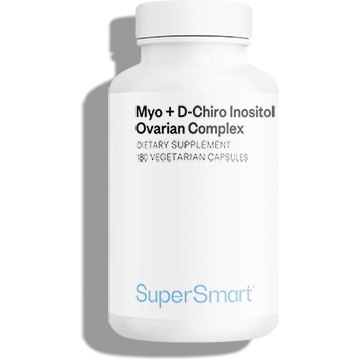
Myo + D-Chiro Inositol Ovarian Complex
Myo-inositol dietary supplement for PCOS and fertility


Complete your selection
Myo + D-Chiro Inositol Ovarian Complex is a natural food supplement designed to support women affected by PCOS (polycystic ovary syndrome) and/or seeking to support their fertility.
Its formula combines a high dose of myo-inositol and an optimal 40:1 myo-inositol/D-chiro-inositol ratio, complemented by other active ingredients and natural micronutrients selected for their benefits on ovarian function.
The supplement is classified in our product category devoted to the female cycle.
Composition and benefits of this dietary supplement for PCOS and fertility
Definition of polycystic ovary syndrome (PCOS) and causes of female infertility
Polycystic ovary syndrome, abbreviated to PCOS, is a female hormonal disorder characterised by an imbalance of hormones that disrupts ovulation.
It generally leads to the presence of cysts in the ovaries (immature follicles that have not ovulated), irregular cycles and difficulty conceiving.
Affecting around 1 in 10 women, this syndrome is one of the most common female hormonal disorders and appears to result from a combination of factors:
- hormonal imbalances, with an overproduction of male hormones (androgens) such as testosterone, which can cause hirsutism and acne. Insulin resistance can also stimulate the ovaries to produce more androgens, which can interfere with ovulation;
- genetic factors;
- chronic inflammation, which promotes insulin resistance and ovarian dysfunction;
- lifestyle factors, as diet, physical inactivity and excess weight can exacerbate these imbalances.
Female infertility, for its part, is often caused by PCOS, hypothalamic dysfunction (stress, excessive physical exercise or insufficient body weight that disrupt signals and prevent ovulation) or hyperprolactinaemia (excess prolactin that interferes with ovulation), apart from other disorders such as tubal, uterine or cervical factors or endometriosis.
Benefits of our 7 ingredients for ovarian health
Our formula brings together the most powerful natural ingredients to help reduce certain manifestations of PCOS, target the mechanisms involved and support female fertility.
Specifically, it contains 7 ingredients:
- inositol in 2 forms, myo-inositol and D-chiro-inositol: inositol is a compound produced naturally by the body in the form of carbohydrate-like molecules known as sugar alcohols. This essential component of cell membranes plays a crucial role in various biological processes: oocyte (egg) maturation, follicular development, insulin sensitivity, reduction of androgen levels and regulation of menstrual cycles, all of which are essential factors in ovulation and fertility. Numerous clinical studies and meta-analyses, sometimes conducted in comparison with drugs, suggest that taking inositol is an effective and safe solution for polycystic ovary syndrome (1-4). More specifically, two stereoisomers of inositol are found in the body: myo-inositol (MI) and D-chiro-inositol (DCI). MI can be converted enzymatically into DCI by the action of the enzyme epimerase. Women with PCOS have a much lower MI/DCI ratio than normal, because hyperinsulinaemia excessively stimulates epimerase activity. For this formula, we have chosen a myo-inositol/D-chiro-inositol ratio of 40:1, established as the most suitable for normalising ovulation in people with PCOS (5);
- berberine from Berberis aristata root extract: berberine is a plant alkaloid that has been extensively studied for its potential role in improving glucose metabolism and insulin sensitivity. Given that excess insulin can stimulate the ovaries to produce more androgens (which disrupts ovulation) and that insulin resistance can affect the uterine mucosa or endometrium (which impairs the implantation of a fertilised egg), berberine's potential benefits for blood sugar regulation make it a particularly relevant compound in the context of PCOS and in favour of fertility (6-9). What's more, our berberine comes from the Berberis aristata plant, which is excellent for the health of the reproductive and urinary organs through its support for metabolic and inflammatory conditions (10);
- resveratrol: resveratrol is a plant-derived polyphenol found in grapes and certain berries. It is being studied for its potential ability to reduce chronic low-grade inflammation, a factor contributing to insulin resistance and ovarian dysfunction in PCOS, and to reduce androgen levels, thereby limiting hyperandrogenic symptoms such as hirsutism and acne (11);
- zinc in the form of bisglycinate: zinc is an essential trace element, notably involved in carbohydrate metabolism and reproductive function. Suboptimal zinc status is frequently observed in women with polycystic ovary syndrome, due to metabolic and inflammatory imbalances. Our inclusion of zinc bisglycinate, an extremely well-assimilated form, aims to compensate for this potential deficiency and thus promote a balanced metabolic and hormonal environment (12);
- vitamin B9 in the form of 5-methyltetrahydrofolate (Quatrefolic®): vitamin B9 is an essential vitamin involved in, among other things, the process of cell division and tissue renewal. These fundamental mechanisms are involved in the proper functioning of reproductive tissue, a particularly important aspect for women with irregular cycles or who are planning to conceive. The contribution of 5-methyltetrahydrofolate (5-MTHF), a highly bioavailable and directly active form of vitamin B9, provided here in its patented, high-quality Quatrefolic® form, helps to maintain a cellular balance favourable to ovarian physiology (13);
- vitamin D3: vitamin D, or the 'sunshine vitamin', is an essential vitamin, but one which is commonly deficient in women with PCOS. This deficiency is associated with insulin resistance, inflammation and hormonal imbalances. Our inclusion of vitamin D3 or cholecalciferol, the form naturally produced by the body, helps you to correct this insufficient status and support an environment more conducive to ovarian health (14).
3 highlights of our myo-inositol supplement for ovarian health
Myo + D-Chiro Inositol Ovarian Complex has 3 strong points:
- a unique synergy of natural ingredients targeting the key symptoms and mechanisms of PCOS: the formula combines inositols, berberine, resveratrol and micronutrients to act in a complementary way on the metabolic and hormonal imbalances observed in polycystic ovary syndrome, for rapid and lasting relief;
- a high dose and a reference ratio of inositols: with 4 g of myo-inositol and a myo-inositol/D-chiro-inositol ratio of 40:1, the formula is based on the most effective configuration, widely used in studies of PCOS and ovarian function;
- overall support for ovarian health and fertility: the combination of active ingredients supports the biological balances linked to follicular maturation, ovulation and female reproductive physiology.
What is in Myo + D-Chiro Inositol Ovarian Complex
Any questions?
Our team of nutrition experts and scientists has the answers.
There is no single definitive treatment for the syndrome in question: treatment depends on your symptoms and your goal (cycles, acne/pilosity, reproductive health, metabolism, etc.).
Women with PCOS are generally advised to:
- improve their lifestyle and insulin sensitivity through diet and physical activity, possibly with the help of inositols
- take the pill and/or anti-androgen treatments on medical advice if hormonal symptoms (acne, hirsutism or irregular cycles) occur
- optimise their metabolic health when planning a pregnancy, followed by ovulation induction using certain drugs, and sometimes a MAP programme
Myo-inositol is commonly recommended in cases of PCOS, irregular cycles, ovulatory imbalances or as part of a pregnancy plan, particularly when insulin sensitivity is impaired.
In addition to women's health, it is also studied for its benefits on metabolic balance, nerve function and, in some cases, male reproductive health.
PCOS is frequently associated with nutritional deficiencies in vitamins and minerals:
- vitamin D is usually low in women suffering from the syndrome, in a context of insulin resistance and hormonal imbalances
- vitamin B9 (folates) levels are sometimes insufficient, particularly in women with irregular cycles or who are planning a pregnancy
- zinc may also be present in reduced quantities, due to metabolic and inflammatory imbalances
- magnesium levels are often low, especially in cases of insulin resistance or chronic stress
Most of these micronutrients are found in our Myo + D-Chiro Inositol Ovarian Complex formula to help address these deficiencies.
Are you familiar with adaptogens, natural substances that help the body adapt to and resist different types of stress (physical, chemical, biological, etc.)? Numerous researchers are looking into their benefits in the context of PCOS. Ashwagandha (Withania somnifera), a shrub native to India, is proving particularly promising, especially for its action on regulating stress and the neuroendocrine axis (in addition to taking Myo + D-Chiro Inositol Ovarian Complex, you can buy our Super Ashwagandha, which is organically produced and has the highest level of active ingredients (with anolides) of any supplement on the market).
Do you suffer from both PCOS and endometriosis? Then take advantage of the benefits of a natural formula dedicated to endometriosis. There are hormone-free supplements that combine ingredients backed by science for their potential ability to reduce endometriosis and its symptoms (buy Endometriosis Support, for example).
Need help?
of experience
your money back
##montant## purchase